
You’ve spent hours perfecting three logo concepts. The files are ready. The mockups look stunning. But when you hit send on that presentation deck, your stomach tightens. Will they love it? Will they ask for seventeen rounds of revisions? Will they pick the weakest option because you didn’t frame it properly?
The truth is, great design work gets rejected every day not because it’s bad, but because it was presented poorly. The way you showcase your logo concepts matters just as much as the designs themselves.
Successful logo presentations combine strategic storytelling, visual context, and structured guidance. Show each concept in realistic applications, explain your design rationale clearly, and limit options to three strong directions. Control the narrative by presenting live when possible, and always tie design decisions back to the client’s business goals and [target audience](https://en.wikipedia.org/wiki/Target_audience) needs.
Prepare the foundation before you design anything
Most presentation problems start long before you open your design software. The designers who consistently win client approval begin with thorough discovery work.
Document everything from your initial client conversations. What words did they use to describe their ideal brand personality? Which competitor logos did they love or hate? What specific business problems does this rebrand need to solve?
Create a simple brief document that summarizes these findings. Share it with your client and get written confirmation that you understood their needs correctly. This becomes your shield later when subjective opinions threaten to derail the project.
Your discovery phase should answer these questions:
- Who is the target audience and what appeals to them?
- What brand attributes must the logo communicate?
- Where will the logo appear most frequently?
- What technical constraints exist (print limitations, embroidery, single-color applications)?
- Who makes the final decision, and what matters most to them?
Limit your presentation to three strong concepts
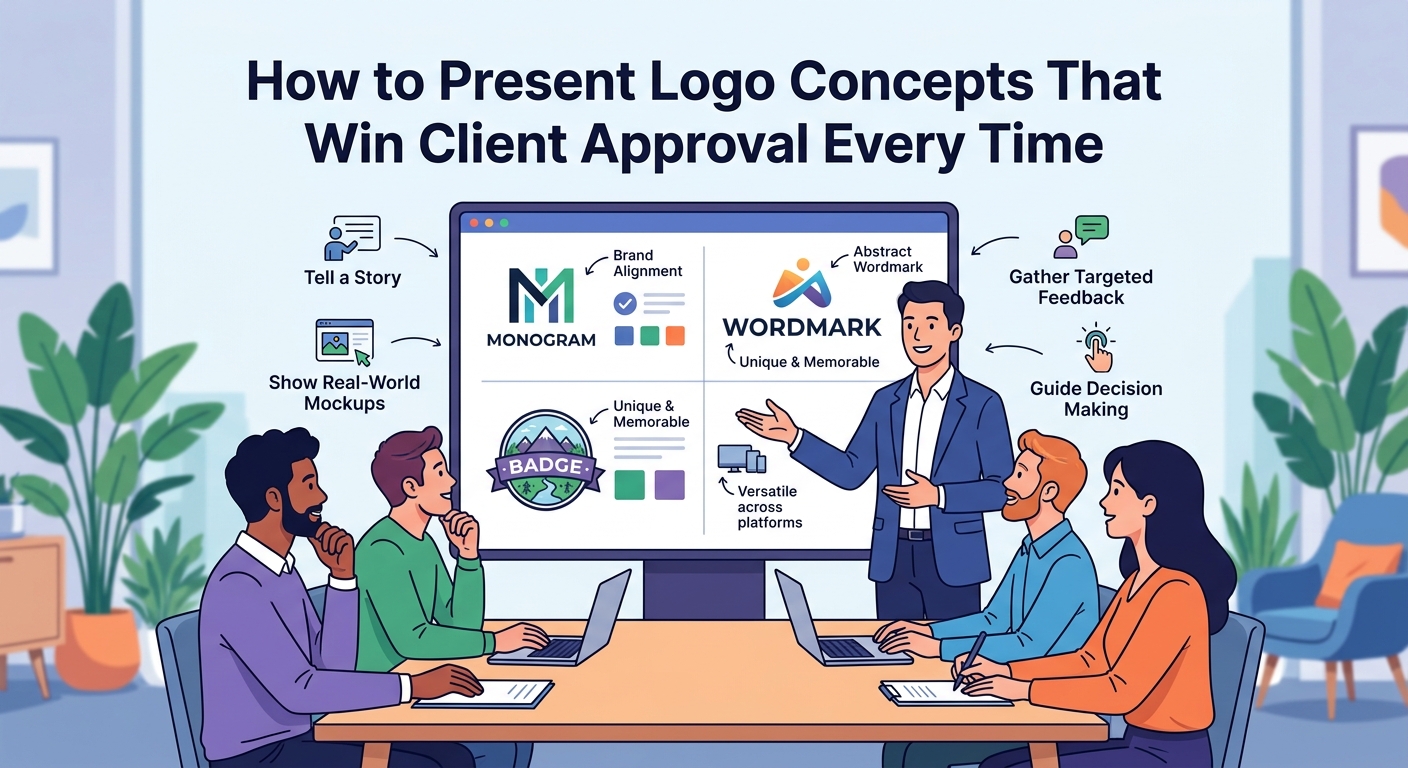
Here’s where many designers sabotage themselves. They present five or six logo options, thinking more choices demonstrate value. Instead, it paralyzes clients and invites endless mixing and matching.
Three is the magic number. It’s enough to show range without overwhelming. It forces you to refine your thinking and present only your strongest work.
Each concept should represent a distinct strategic direction, not minor variations of the same idea. If two concepts feel too similar, cut one. Your job is to guide the client toward the best solution, not to be a logo vending machine.
Structure your three concepts like this:
- The safe choice: Professional, proven, slightly conservative. This option reassures nervous stakeholders.
- The recommended choice: Your best strategic solution. Balanced between innovation and approachability.
- The bold choice: Pushes boundaries while staying appropriate. Shows creative range and gives context to option two.
This structure gives clients a framework for decision-making. They can see the spectrum of possibilities and usually land on the middle option, which is exactly where you wanted them.
Show each logo in realistic context
A logo floating on a white artboard tells the client nothing. They can’t visualize how it functions in the real world. They’ll default to personal taste instead of strategic thinking.
Context transforms abstract shapes into tangible brand assets. Show every concept applied to the actual touchpoints where it will live.
For a restaurant, that means menus, signage, staff uniforms, and takeout packaging. For a tech startup, show the logo on app icons, website headers, LinkedIn banners, and investor pitch decks. Make it feel real.
Use high-quality mockups that match the client’s industry and aesthetic. A artisanal bakery logo shouldn’t be shown on sleek tech devices. A fintech startup logo doesn’t belong on rustic kraft paper.
Include applications that demonstrate versatility. Show the logo large and small. In color and black-and-white. On light backgrounds and dark backgrounds. This proves the design actually works, not just looks pretty.
Build a presentation deck that tells a story
Your presentation should flow like a narrative, not read like a police lineup of logo options. Structure matters enormously.
Start with a brief recap of the project goals and target audience. This reminds everyone what success looks like before opinions start flying. Anchor the conversation in strategy, not aesthetics.
Present one concept at a time. Don’t show all three logos on a single slide for comparison. That invites superficial judgments and Frankenstein feedback (“Can we use the icon from option one with the colors from option three?”).
For each concept, follow this sequence:
- Show the logo clean on a neutral background
- Explain the strategic thinking behind it
- Display it in multiple realistic applications
- Highlight how it solves the specific problems identified in discovery
Use your discovery document language when explaining rationale. If the client said they wanted to feel “approachable but professional,” echo those exact words when describing how your design achieves that.
Avoid design jargon. Don’t talk about negative space, golden ratios, or optical adjustments unless the client has a design background. Instead, translate design decisions into business benefits. “The rounded letterforms make the brand feel friendly and welcoming to first-time customers” works better than “The geometric sans-serif has humanist proportions.”
Present live whenever possible
Email presentations invite disaster. The client reviews your work while distracted, without your guidance, and often shares it with people who weren’t part of the discovery process.
Live presentations let you control the narrative, read the room, and address concerns in real time. You can see facial expressions, hear tone of voice, and adjust your approach accordingly.
Schedule a video call or in-person meeting. Walk through the presentation yourself. Maintain control of the screen so clients see concepts in the order you intended, not jumping ahead to compare options prematurely.
During the presentation, pause after showing each concept’s applications. Let the work breathe. Resist the urge to fill silence with nervous chatter. Give clients time to absorb what they’re seeing.
After presenting all three concepts, ask open-ended questions. “Which direction feels most aligned with your brand goals?” works better than “Which one do you like?” The first question invites strategic discussion. The second invites personal preference.
Handle feedback like a professional
Clients will have opinions. Some will be helpful. Others will be baffling. Your job is to listen carefully, separate useful feedback from subjective taste, and guide the conversation productively.
Take notes on everything they say, even if you disagree. Clients need to feel heard. Acknowledge their concerns before responding. “I understand why that color choice feels too bold for your industry. Let me explain the research behind that decision” disarms defensiveness.
Ask clarifying questions when feedback is vague. “Make it pop” or “it needs more energy” mean nothing actionable. Dig deeper. “When you say it needs more energy, are you concerned it won’t stand out against competitors, or does it not reflect the brand personality we discussed?”
If clients want to combine elements from different concepts, gently push back. Explain that each logo was designed as a complete system, and mixing elements usually weakens both concepts. Offer instead to refine their preferred direction based on elements they liked from other options.
Some battles aren’t worth fighting. If a client insists on a change that won’t harm the design’s effectiveness, even if you think it’s unnecessary, make the change. Save your credibility for decisions that truly matter.
Create a comparison framework that guides decisions
Clients often struggle to articulate why they prefer one option over another. Give them a structured way to evaluate each concept against objective criteria.
Create a simple comparison table that rates each logo against the goals established in discovery. This shifts conversation from “I like it” to “Does it work?”
Here’s an example framework:
| Evaluation Criteria | Concept 1 | Concept 2 | Concept 3 |
|---|---|---|---|
| Appeals to target audience | Strong | Moderate | Strong |
| Communicates brand personality | Moderate | Strong | Strong |
| Works at small sizes | Strong | Strong | Moderate |
| Stands out from competitors | Moderate | Strong | Strong |
| Versatile across applications | Strong | Moderate | Moderate |
| Timeless vs. trendy | Strong | Strong | Moderate |
This table doesn’t make the decision for clients, but it provides a rational framework for discussion. It also validates your strategic thinking and shows you’ve considered practical implementation, not just aesthetics. If you’re also delivering the complete logo file format guide, this evaluation helps ensure the chosen concept will work across all necessary formats.
Address common objections before they arise
Experienced designers know which concerns pop up repeatedly. Address them proactively in your presentation.
“It looks too simple”: Explain that simplicity aids recognition and reproduction. Show examples of iconic brands with deceptively simple logos. Demonstrate how the logo maintains impact when reduced to app icon size or embroidered on a polo shirt.
“Can we see it in different colors?”: If you’ve chosen colors strategically, explain why. Show the color psychology research. Demonstrate how your palette differentiates from competitors. Offer to provide alternate colorways after the core concept is approved, not before.
“My spouse/friend/neighbor doesn’t like it”: Gently remind clients that their personal network isn’t the target audience. Redirect to the customer profiles you developed together during discovery.
“It doesn’t look like [competitor] logo”: Good. That’s the point. Explain why differentiation matters and how copying competitor aesthetics would position them as a follower, not a leader.
Follow up with a clear next step summary
After the presentation meeting, send a concise email that recaps the discussion and outlines what happens next. This prevents misunderstandings and keeps the project moving forward.
Your follow-up should include:
- Brief summary of which concept(s) the client preferred
- Specific feedback points you’ll address in the next round
- Clear deadline for client to provide any additional thoughts
- Timeline for delivering refined concepts
- Reminder of what you need from them to proceed
Attach a PDF of the presentation deck for reference, but make sure it’s the version you walked through together, not a standalone document meant to be understood without your narration.
Set a reasonable deadline for client feedback. “Please share any additional thoughts by Friday” prevents projects from stalling indefinitely while stakeholders deliberate.
Manage revisions with boundaries and structure
Even the best presentation will likely lead to revision requests. How you handle this phase determines whether the project concludes smoothly or spirals into endless tweaks.
Clarify revision limits upfront in your contract. Two rounds is standard. Explain that revisions mean refinements to the approved direction, not exploring entirely new concepts. That ship sailed after the initial presentation.
When clients request revisions, ask them to consolidate all feedback into a single document. This prevents the drip-feed of changes where you make an adjustment, send it back, and immediately receive another change request.
Present revisions the same way you presented initial concepts. Show them in context with clear explanations of what changed and why. Don’t just email updated files and hope for the best.
If revision requests start contradicting earlier approved decisions, refer back to your notes from previous meetings. “Last week you mentioned the rounded style felt more approachable. This revision request would make the letterforms more angular. Can you help me understand what changed?” This usually helps clients recognize they’re second-guessing themselves.
Prepare clients for the long-term relationship with their logo
A logo isn’t a one-and-done transaction. It’s the foundation of a visual identity system that will evolve with the business. Set this expectation during your presentation.
Explain that initial reactions to a new logo are often uncertain. It takes time for any brand mark to feel familiar and “right.” Share examples of famous logos that faced initial criticism but became beloved over time.
Discuss how the logo will need supporting elements to function as a complete brand system. This is your opportunity to mention how to build a brand style guide that actually gets used and position yourself for additional work.
Talk about implementation strategy. Which applications launch first? How will they introduce the new logo to existing customers? What’s the rollout timeline? This shifts the conversation from whether they like the logo to how they’ll use it successfully.
The best logo presentations don’t ask “Do you like it?” They demonstrate “Here’s how this solves your business challenges and connects with your customers.” Frame every design decision as a strategic choice, not an aesthetic preference.
Common presentation mistakes that kill approval rates
Learning what not to do is just as valuable as knowing best practices. These mistakes appear in failed presentations repeatedly.
Showing too many options: More than three concepts suggests you don’t have a clear strategic recommendation. It makes you look indecisive and overwhelms clients.
Presenting via email without context: Your carefully crafted designs get reviewed during a bathroom break while the client’s kid screams in the background. You lose all control over the narrative.
Using generic mockups: Showing a law firm logo on a coffee cup or a restaurant logo on a tech device destroys credibility. Clients notice when mockups don’t match their industry.
Explaining design theory instead of business value: Talking about kerning and color theory impresses other designers, not clients. They care about results, not process.
Letting clients compare all options side-by-side too early: This invites Frankenstein feedback and superficial judgments based on personal taste rather than strategic fit.
Not connecting designs back to discovery: If you can’t draw a clear line from client’s stated goals to your design decisions, you haven’t done your job.
Accepting vague feedback without clarification: “Make it more modern” could mean anything. Always dig deeper to understand the real concern.
Understanding what makes a brand memorable helps you explain your design choices in terms clients understand and value.
Build confidence through preparation and practice
Even experienced designers get nervous before big presentations. The antidote is thorough preparation.
Rehearse your presentation out loud. Time yourself. Identify awkward transitions or unclear explanations. Practice until your narrative flows naturally without reading from notes.
Anticipate questions and prepare answers. What if they hate all three options? What if they ask why you didn’t include their original idea? What if they want to see the logo in an application you didn’t mockup? Have responses ready.
Test your technology before the meeting. Ensure your screen sharing works. Check that mockup images display correctly. Have a backup plan if your internet connection fails.
Prepare your mindset. You’re not begging for approval. You’re a professional presenting strategic solutions to business challenges. Your expertise has value. Confidence (not arrogance) makes clients trust your recommendations.
If you’re struggling with the technical aspects of logo design itself, resources like avoiding common logo design mistakes and choosing the right font pairing can strengthen your core skills before the presentation phase.
Adapt your approach for different client types
Not all clients need the same presentation style. Read your audience and adjust accordingly.
Corporate clients with committees: Expect longer approval processes and multiple stakeholders. Provide detailed rationale documents they can share internally. Focus heavily on how the logo supports business objectives and differentiates from competitors.
Startup founders: They often have strong personal opinions and want to be involved in every decision. Give them more context about design trends in their industry. Show how the logo will scale as they grow.
Small business owners: They’re investing significant personal resources and may feel anxious about the decision. Provide extra reassurance. Show more applications so they can visualize the logo in their daily operations.
Nonprofit organizations: Mission alignment matters enormously. Connect every design decision to their values and the emotions they want to evoke in donors or volunteers.
Established brands rebranding: They’re dealing with legacy and customer attachment. Show evolution, not revolution. Demonstrate respect for brand equity while solving current problems.
Turn your presentation into a repeatable system
Once you’ve refined your presentation approach, systematize it. Create templates and checklists so you can deliver consistent quality without reinventing the wheel each time.
Build a presentation deck template with your standard structure. Create a library of high-quality mockup templates organized by industry. Develop a discovery questionnaire that captures the information you need every time.
Document your process. Write down the questions that generate useful client insights. Note which explanations resonate and which fall flat. Track which mockup applications clients respond to most strongly.
This systematization doesn’t make your work formulaic. It frees your creative energy for design instead of wasting it on presentation logistics. You’ll deliver better results faster.
Consider creating a brand style guide template that you can adapt for each client, positioning it as the natural next step after logo approval.
Your presentation skills matter as much as your design skills
The most talented designer in the world will struggle to build a successful practice without strong presentation abilities. Your logo concepts don’t speak for themselves. You must be their advocate.
Treat presentation development as a core professional skill worth continuous improvement. Record your presentations and review them critically. Ask trusted colleagues for feedback. Study how other designers present their work.
Read books on persuasion and storytelling. Take a public speaking course. Learn basic sales psychology. These skills complement your design abilities and dramatically increase your approval rates.
Remember that rejection often has nothing to do with design quality. Projects fail because of poor communication, misaligned expectations, or inadequate discovery work. Your presentation is where you address all of these potential failure points.
Making your next presentation your best one
The difference between designers who struggle with client approval and those who consistently win it often comes down to presentation approach. Great design work deserves great presentation.
Start applying these methods with your next project. Limit yourself to three strong concepts. Show everything in realistic context. Present live instead of via email. Build a narrative that connects design decisions to business goals. Guide clients toward strategic thinking instead of personal preference.
Your confidence will grow with each successful presentation. You’ll develop instincts for reading client reactions and adjusting your approach in real time. The anxiety that once accompanied hitting send on that presentation deck will transform into excitement about showcasing your strategic thinking.
The logos you design solve real business problems for real people. Present them that way, and approval will follow naturally.
