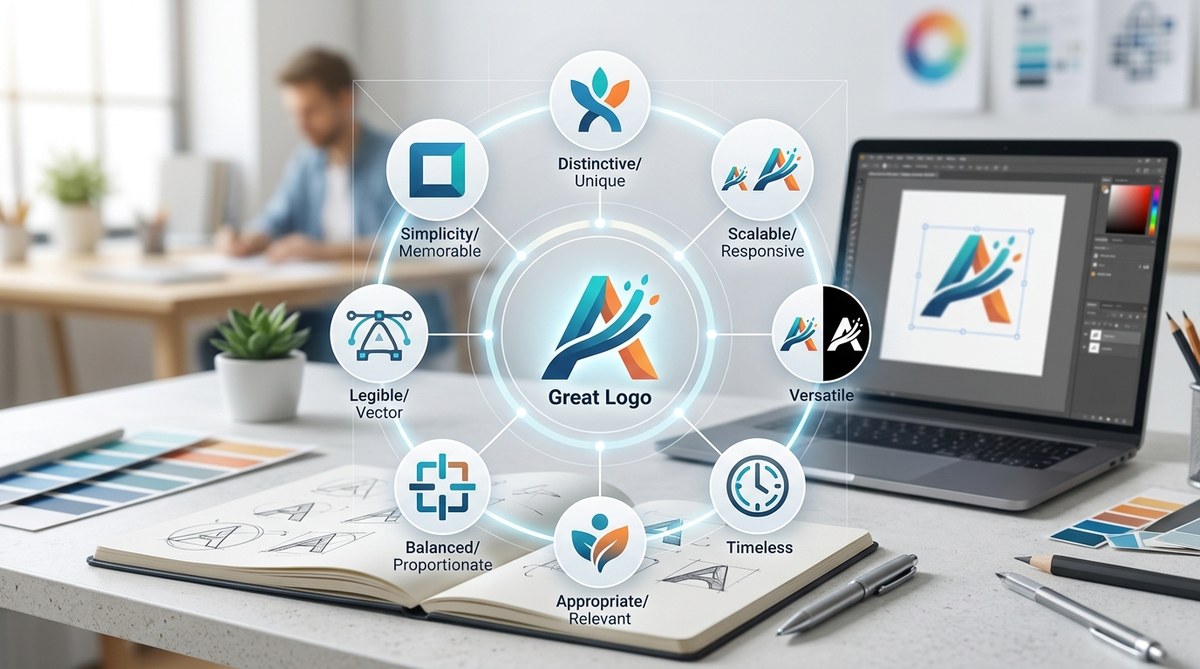
A logo is more than a pretty graphic. It is often the first handshake between your brand and a potential customer. That tiny square on a website tab, the emblem on a coffee cup, the mark on a delivery box. Every time someone sees it, your logo has a job to do. It needs to signal trust, share a hint of your personality, and stick in the memory long after the screen goes dark. Getting that right takes more than luck. It takes understanding the core ingredients that turn a simple drawing into a brand asset that works for years.
A great logo balances simplicity, memorability, relevance, and versatility. It should work in one color, at the size of a postage stamp, and on a billboard. The best logos avoid trendy gimmicks, use intentional typography, and lean on color psychology to connect with the right audience. This guide breaks down eight non-negotiable elements that separate forgettable marks from iconic brand symbols.
What Makes a Logo Truly Great?
A great logo does not shout for attention. It earns it through restraint. When you look at the most recognizable marks in the world, you notice something. They are simple enough to draw from memory. They work on a business card and a highway sign. They do not rely on a single trendy font or color that will look dated next year.
For small business owners and designers working with real budgets and real timelines, chasing trends is a trap. What matters is building a foundation that lasts. Let us walk through the eight elements that separate a forgettable graphic from a logo that actually builds brand recognition.
1. Simplicity Is a Superpower
The most effective logos are often the least complicated. Think about the Nike swoosh or the Apple apple. You can describe both in one sentence. That is the test. If you need a paragraph to explain what your logo is supposed to be, it is probably too complex.
Simplicity makes your logo work across every medium. A detailed illustration with tiny text looks great on a 27-inch monitor. On a mobile screen or a pen, it turns into a blurry mess.
Why simplicity matters in 2026 more than ever. Attention spans are short. People scroll past content in milliseconds. Your logo needs to be readable at a glance, not studied like a painting.
Here is a checklist to test your logo for simplicity:
- Can you trace the main shape with your finger in under three seconds?
- Would the logo still be recognizable if you removed the text?
- Does the design use more than three visual elements (shapes, lines, text blocks)?
- Can a stranger describe the logo after seeing it for two seconds?
If you answered no to any of those, your design may need editing. Cutting elements is hard, but it is almost always the right move.
2. Memorability That Sticks
A memorable logo does not have to be loud or flashy. It just needs to leave a fingerprint in the viewer’s mind. That happens when the design has a single distinctive feature.
What makes a logo memorable? It is usually one unexpected thing. The arrow in the FedEx logo. The bite in the Apple. The missing leg on the Amazon arrow that forms a smile. That tiny surprise is what people recall.
For your own logo, ask yourself: what is the one detail someone would mention if they tried to describe your logo to a friend? If the answer is “nothing really,” you have more work to do.
3. Timelessness Over Trends
Trends are tempting. They feel fresh and exciting in the moment. But a logo that follows a trend today will look dated tomorrow. The goal is not to look like 2026. The goal is to look like your brand, regardless of the year.
Trends to handle with care in 2026:
- Gradients that mimic a sunset or neon glow
- Overly geometric sans serif fonts that feel “techy”
- Mascots that rely on meme culture
- Complex line art that requires a high-resolution screen to read
None of these are inherently bad. But if your logo depends on a trend to feel relevant, it will expire. Timeless logos use classic shapes, clean typography, and restrained color palettes that do not anchor them to a specific era.
4. Relevance to Your Audience
A great logo fits its industry, its audience, and its brand personality like a tailored jacket. A law firm logo and a children’s toy brand logo should not look like they came from the same template. Relevance means your visual choices signal the right message to the right people.
Questions to check relevance:
- Does the logo style match the tone of your brand (serious, playful, luxurious, friendly)?
- Would your target customer feel drawn to the design?
- Does the logo avoid visual cliches that blend in with competitors? (Looking at you, blue circle tech logos.)
If your brand sells organic baby products, a sharp, angular logo with harsh black lines sends the wrong signal. If you run a construction company, a delicate script font feels out of place. Match the visual language to the message.
5. Versatility Across Every Channel
Your logo will live in many homes. A website header. A social media avatar. A printed invoice. A sign on a storefront. A sticker on a product. It needs to look good everywhere.
The one-color test. This is the gold standard for versatility. Print your logo in solid black on a white sheet of paper. If it still communicates your brand clearly, you are in good shape. If it becomes a muddy, unreadable blob, go back to the drawing board.
Versatility also means having the right file formats. You need vector files (SVG, EPS, AI) for scaling to any size without pixelation. You need a horizontal and vertical version. You need a simplified icon version for small spaces like a favicon.
| Format | Best Use | Why It Matters |
|---|---|---|
| SVG or EPS | Web and print at any size | Scales infinitely without quality loss |
| PNG with transparent background | Social media and digital use | Works on any background color |
| JPG | Documents and presentations | Smaller file size, good for non-transparent use |
| Client delivery and printing | Preserves vector data and fonts |
6. Smart Typography Choices
Custom lettering or a well-chosen font can make or break a logo. Typography carries personality. A serif font feels traditional and trustworthy. A sans serif feels modern and clean. A script font feels personal and artistic.
Rules for logo typography in 2026:
- Avoid using more than two fonts in a single logo lockup
- Never stretch or distort a font. If you need a taller look, choose a typeface with a condensed variant
- Do not use a font that is overly trendy. Stick to timeless type families that have been around for decades
- If you use a custom wordmark, make sure the letter spacing (kerning) feels balanced. Nothing screams amateur like uneven spacing between letters
For a deeper breakdown on font selection, check out our guide on how to choose the perfect font for your brand identity. It covers pairing, licensing, and readability across sizes.
7. Intentional Color Psychology
Color is not decoration. It is a signaling tool. Each hue carries emotional weight that varies by culture and context. In the United States, blue suggests trust and stability (think banks and healthcare). Red suggests energy and urgency (think food brands and clearance sales). Green suggests growth and nature.
A simple color checklist:
- Limit your logo palette to two or three colors maximum
- Test the logo in grayscale to ensure it works without relying on color
- Check contrast ratios for accessibility, especially if the logo sits on different backgrounds
- Avoid color combinations that are hard for colorblind viewers to distinguish, like red and green together
For a full breakdown on picking the right palette, read our guide on how to choose brand colors that actually convert customers. It includes a step-by-step process for selecting hues that align with your brand values.
8. A Clear Visual Hierarchy
Your logo likely combines a symbol and text. The way those two elements relate to each other matters. Which one is dominant? Which draws the eye first?
Three common hierarchy structures:
- Symbol dominant. The icon sits above or to the left of the name. Best for brands that want the mark to become the primary identifier over time.
- Text dominant. The brand name is the star. The symbol is small or absent. Best for newer brands that need name recognition first.
- Combination lockup. Symbol and name sit side by side, equally balanced. Best for flexible branding that works in multiple contexts.
The hierarchy should feel intentional. If the symbol and text fight for attention, the logo feels busy. Decide what matters most and let that element lead.
“A logo is not the brand itself. It is a doorway to the brand. The design should invite someone in, not explain everything at once.” — Debbie Millman, designer and brand strategist
The 5-Step Logo Design Process
If you are starting from scratch, follow this practical process. It keeps you focused on results instead of getting lost in aesthetics.
- Research your market. Look at competitors, audience preferences, and industry norms. You are not copying. You are understanding the visual language your audience already trusts.
- Sketch concepts on paper. Do not open software yet. Draw at least 20 thumbnail sketches. Quantity leads to quality. The best ideas often come after the obvious ones are out.
- Refine the top three ideas. Take your strongest sketches and build them in vector software. Test each one in a single color. Show them to people who match your target audience.
- Gather honest feedback. Ask specific questions. Does this feel trustworthy? Does this remind you of another brand? Would you remember this after one look? Avoid asking “Do you like it?” which invites vague opinions.
- Finalize and create a usage guide. Once you pick the winner, document how it should and should not be used. Include clear space rules, minimum size limits, color codes, and wrong usage examples.
Common Logo Design Mistakes to Skip
Mistakes happen when we rush or follow bad advice. Here are the ones to watch for.
- Using too many fonts. Stick to one or two. Three fonts in one logo looks chaotic and unprofessional.
- Adding clip art or stock icons. Your logo should be original. A generic leaf or globe icon says “I ran out of ideas.”
- Following trends blindly. What is popular right now will look dated in a few years. Design for your brand, not for Instagram.
- Ignoring scalability. If your logo only works at one specific size, it is not a logo. It is a picture.
- Relying on color to carry the design. A logo should work in black and white first. Color is the bonus, not the foundation.
For a more comprehensive list, read about 7 logo design mistakes that make your brand look unprofessional. It covers real examples and how to fix each issue.
How to Test Your Logo Before You Commit
Before you print business cards or update your website, run your logo through a simple test battery.
- The squint test. Squint your eyes until the details blur. Does the overall shape still read clearly? If it becomes a blob, the silhouette is weak.
- The small screen test. Resize your logo to 16×16 pixels (favicon size). Can you still tell what it is? If not, create a simplified version for tiny spaces.
- The stranger test. Show the logo to someone who has never seen your brand. Ask them to guess what your business does. If they guess wrong, the visual signals are off.
- The one color test. Print it in solid black. No shades, no gradients. If the message still works, your logo is built on a strong foundation.
Building Your Logo Into a Full Brand System
A logo does not exist in a vacuum. It lives alongside fonts, colors, photography style, and voice. When these pieces work together, your brand feels cohesive. When they do not, it feels messy.
If you already have a logo and want to build the rest of the visual identity, start with our brand audit checklist. It walks through every touchpoint your brand touches, from email signatures to packaging, and helps you spot inconsistencies.
Your Logo Is the Start, Not the Finish
Creating a great logo is one of the most rewarding steps in building a brand. It is a small piece of design that carries a huge weight. When you get the elements right, your logo stops being just a graphic. It becomes a shortcut for trust.
Do not overthink perfection. Start with simple shapes, intentional colors, and a font that feels like your brand. Test it in the real world. Listen to feedback. Edit ruthlessly. Your logo does not need to please everyone. It needs to please the right people and stay recognizable for years to come.
If you want to go deeper, take a look at what makes a brand memorable: 7 psychology-backed design principles. It connects the dots between design choices and how people actually remember brands.
Now it is time to put these elements into action. Pick one logo you are working on, run it through the eight criteria here, and see where it scores lowest. That is where you start improving. One edit at a time.
