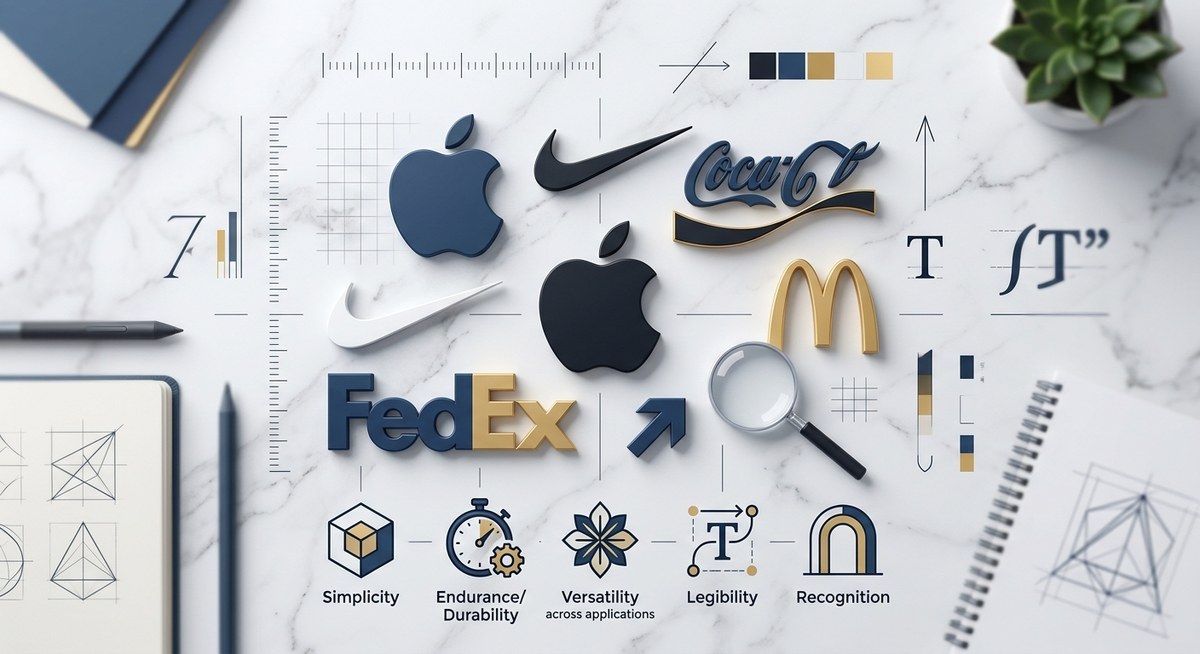
You see a Nike swoosh and instantly think of athletic performance. The Apple icon tells you the device in your pocket is premium and intuitive. Coca-Cola’s script feels like a cold glass of nostalgia. These logos haven’t just survived decades; they’ve become cultural shorthand. But what exactly gives a logo that kind of staying power? It isn’t luck. It isn’t a massive marketing budget. It’s a set of design decisions made at the very beginning that let a mark age gracefully while the world changes around it. Let’s break down those decisions so you can apply them to your own work.
A timeless logo relies on simplicity, versatility, color restraint, strong typography, and a deep connection to brand purpose. By stripping away trends and focusing on what the brand stands for, you create a mark that works on a billboard and a smartwatch alike. This article gives you the principles, a step-by-step process, and real-world examples to build your own lasting identity.
The Core Principles of Timeless Logo Design
Timeless logos share a handful of traits. They don’t follow fads. They don’t rely on gradients that will look dated in three years. Instead, they are built on structural fundamentals that remain effective as long as human perception stays the same.
- Simplicity above all. A simple shape is easier to recognize and remember. The Nike swoosh has no text, no color gradient, no unnecessary lines. It’s a single curved stroke that reads instantly at any size.
- Versatility across media. Your logo must work in black and white, on a tiny favicon, on a giant billboard, embroidered on a hat, and as a watermark in a video. If it only looks good in full color at 500 pixels, it’s not timeless.
- Smart use of color. Limit your primary palette to one or two colors. Coca-Cola’s red is so iconic that the brand can often drop the name and just use the color block. When you overcomplicate the palette, you lose that mental shortcut.
- Typography that matches the brand voice. Custom or carefully chosen lettering builds personality. Coca-Cola’s flowing script feels classic and warm. IBM’s bold sans-serif feels stable and efficient. Choose a typeface that won’t feel like a relic of the 2010s in a few years.
- Meaning that goes beyond decoration. A timeless logo often tells a story or contains a hidden idea. The FedEx arrow between the E and the x communicates speed and direction. That kind of thoughtful detail rewards repeat viewing without distracting from the overall shape.
Lessons from Iconic Brands That Got It Right
Let’s look at three household names and see exactly how they applied those principles.
Nike started with a simple checkmark (the swoosh) and the word “Nike” in a custom typeface. Over time the brand dropped the word entirely. The swoosh alone carries the full weight of the brand. What makes it timeless? It’s abstract enough that it doesn’t look like any specific animal or object, yet it suggests motion, speed, and forward momentum. It works in any color. It scales from a shoe tongue to a stadium banner.
Apple went from a complex rainbow illustration to a single monochrome apple with a bite. That bite is crucial: without it, the shape would look like a cherry or a generic sphere. The bite adds character and a subtle pun (byte/bite). Apple’s logo has remained essentially unchanged for decades because it’s simple, friendly, and instantly recognizable even when rendered in a single line.
Coca-Cola has kept its Spencerian script since the 1880s. The brand has updated the background ribbon and the color treatment, but the wordmark itself is nearly untouched. Why does it work? The flowing letters feel handcrafted and warm. The red color triggers associations with energy and excitement. Most importantly, the shape is unique enough that you can spot it from across a room, even if the text is unreadable.
These brands prove that a logo doesn’t need to be redesigned every five years. It needs to be designed right the first time.
The Timeless Logo Design Process
If you’re starting a new logo or refreshing an existing one, follow these six steps to steer clear of trendiness and toward longevity.
- Research the brand’s core identity. Talk to the business owner or stakeholders. What is the single most important thing the brand stands for? Write it in one sentence. The logo must express that sentence visually.
- Sketch in black and white first. Remove color from the equation. If the shape doesn’t work in black and white, adding color won’t fix it. This forces you to focus on silhouette, proportion, and negative space.
- Test at extreme sizes. Reduce your sketch to 16×16 pixels. Does it still read? Enlarge it to billboard scale. Are the lines too thin? Adjust until it works at both ends.
- Choose one primary color and one accent. Stick to a tight palette. Avoid gradients unless they serve a specific purpose (like a sunset for a travel brand). Gradients can look dated fast.
- Select or commission a typeface that feels like the brand. If the logo includes a wordmark, the font is as important as the icon. Custom lettering is ideal, but a well-chosen existing typeface can also be timeless. Think of how Helvetica helped IRS and American Apparel look authoritative.
- Create a brand style guide for usage. A logo alone isn’t enough. Set rules for clear space, minimum size, incorrect color uses, and alternative versions (horizontal, stacked, icon-only). Without these guidelines, people will stretch, recolor, and misuse your mark until it loses its integrity. If you need help structuring that, our article on how to build a brand style guide that actually gets used covers the essentials.
Common Mistakes That Kill Timelessness
Even seasoned designers slip into habits that shorten a logo’s lifespan. Here’s a table of what to avoid and what to do instead.
| Mistake | Why It Fails | Timeless Alternative |
|---|---|---|
| Using trendy effects (shadows, glows, bevels) | These date the logo to the software era when they were popular. | Flat, solid shapes that don’t rely on simulated depth. |
| Overly complex illustrations | Hard to reproduce at small sizes or in one color. | Simplify to the point where you can’t remove another line without losing meaning. |
| Relying on color for recognition | Works only when full color is available. Black-and-white test fails. | Design in monochrome first. Color is a bonus, not a crutch. |
| Following industry clichés (e.g., a mountain for an outdoors brand) | Makes the brand look generic and interchangeable. | Find a unique visual metaphor that belongs to your specific brand story. |
| Too many typographic styles | Creates visual noise and confusion. | Stick to one or two font weights maximum. |
Expert Advice from a Brand Strategist
I asked Jordan Chen, a brand identity consultant who has worked with startups and Fortune 500 companies, what he tells clients who want a logo that will last.
“The biggest mistake I see is people trying to look ‘modern.’ Modern is the enemy of timeless. Instead, ask yourself: would this logo have worked in 1970? Would it work in 2070? If the answer is yes to both, you’re on the right track. Also, never let a client approve a logo on a smartphone screen. Always show it at actual use sizes. A design that looks beautiful on a 6-inch screen can look like a blurry blob on a storefront.”
That advice rings true for every project. When you prioritize clarity over flash, you give your logo its best shot at a long life.
Build Your Own Timeless Mark
Now it’s your turn. Take the principles we covered and apply them to your next logo project. Start with research. Sketch in black and white. Test at extremes. Choose a restrained color palette. Pick typography that echoes the brand’s voice. And document everything in a style guide so your logo stays consistent across all touchpoints.
Remember, a timeless logo doesn’t need to be boring. It just needs to be intentional. The Nike swoosh is one of the simplest shapes ever drawn, and it’s one of the most powerful. Simplicity doesn’t mean lack of personality. It means that every line, curve, and color earns its place. Strip away the unnecessary, and what remains becomes unforgettable.
If you’re still unsure whether your current logo is working against you, run a brand audit checklist to see if it passes the test. And for a deeper look at how the biggest brands build whole visual systems, our piece on the anatomy of iconic brand identities is a great companion read.
Go make something that lasts.
